


Human-shaped, monkey-loving, robot-fighting, pirate-hearted, storytelling junkie, Mark A. Rayner is an award-winning author and playwright. His short fiction has appeared in, among other distinguished publications, The Saturday Evening Post, Abyss & Apex, Paradox Magazine, and Corvus Review. A hybrid author, he has published five novels and two collections of short stories and has had several plays produced.
Rayner is also the co-host of Re-Creative, a podcast about the art that inspires creativity, and teaches digital production and theory at the Faculty of Information and Media Studies at Western University in Canada. He does all of these things while being Canadian and owning cats.
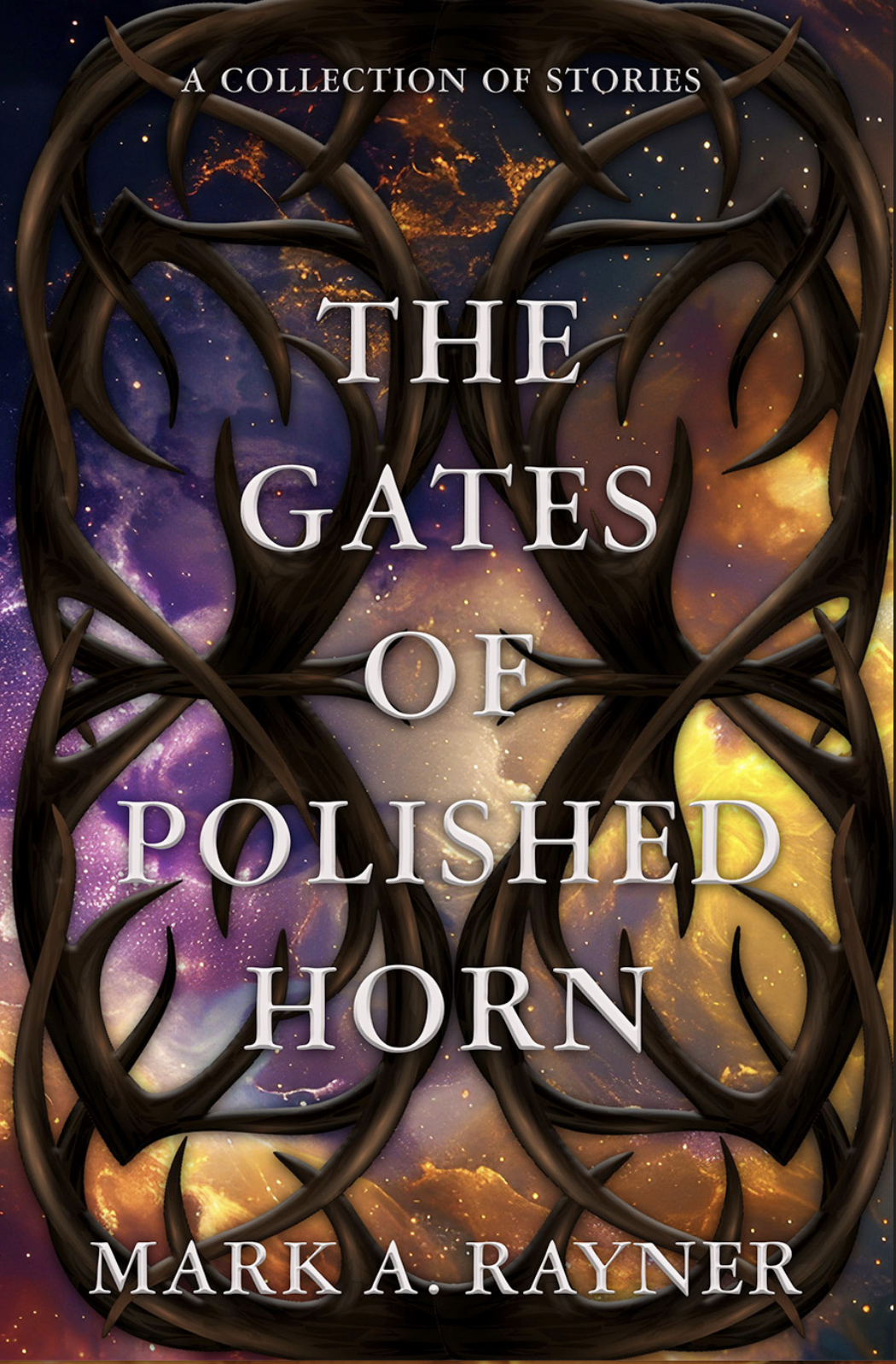
The short-story collection this interview focuses on.
Before I answer these excellent questions, there’s just one thing I want to say, which is that any answer the reader has for these is perfectly valid. I do believe that once the author is done writing, all the power flows from the reader. All the interpretation is the reader’s. Did I have intentions when writing these stories? Absolutely. Was I completely aware of all the implications of everything I wrote? I’d love to say that I was, but the reality is that the best writing I do is powered by my subconscious; my thinking brain may guide the ship—and it certainly has the hand on the wheel when I’m working on second and third drafts—but it doesn’t call all the shots. So, take these answers with a dollop of salt.
The Real Primo
PAT The story begins with the narrator asserting, "Would you believe me if I told you Buddha had the set-up all wrong?" Is the set-up the idea of reincarnation or something else? What is the role of "no self" in this?
Primo's life is short and devoid of what we might call outstanding achievement. Yet you imbue him with enough humanity for us to care what happens in that short life. In fact, it is the ordinariness of his life that makes him a sympathetic character. The awful act performed by his "uncle" changes the quality of that ordinariness, however. What made you decide to make that change?
The last line of "The Real Primo" is "So when the crash came, there was no Primo. There was no--" I assume we are supposed to think that the narrator was correct about the Buddha having things wrong and is interrupted in the act of proving himself correct. Is that right, or is there a deeper paradox you are trying to create?
MARK All great questions! Here’s my interpretation of the story. Primo is encountering samsara, the Buddhist concept that there is a cycle of life and rebirth that all beings experience, but it’s not exactly the one Buddha described. It’s not a new body, a new life, it’s a recreation of his previous life. Perversely, in Buddha’s rebirth, we’d have a chance to make new decisions with a new life, but Primo is locked into the one—he can’t have an impact on what happened in his life because it already happened. This makes Primo a kind of non-entropic time traveller. So, the setup from Buddha is wrong, but the answer to Primo’s dilemma can be found in Buddha’s wisdom regardless. His second noble truth, if I can paraphrase, is that all suffering is caused by attachment. But attachment to what?
He attempts to discover this. As you observe, he’s an ordinary human and that’s definitely something I wanted to explore. That includes the terrible things that happen to ordinary folks, as the intrusion by Primo’s “uncle” is. There is a recognition of this, but this doesn’t become the fact of his life that he’s attached to. Nor are his loves. Eventually, the hero discovers that it is attachment to the very idea that he exists. Once he realizes that he doesn’t, the story ends. Buddha was wrong about the setup but not the central insight.
The Consolation of Victory
PAT This story has a wonderful self-reflexive moment: a professor says, "Were they lovers? Somehow the thought offended me, and I felt a sense of shame. I'd been living under the empire's rule my whole life—at least, what I could remember of my life—and I suddenly realized that I had absorbed their prejudices too." A professor also appears in "After the Internet." In response to an event or opportunity, each man does something to challenge the safe, sheltered life of the academic and to suggest his greater potential. Do you think there is something about academia that is inherently limiting?
MARK I really don’t think there is, and if anything, I believe it is the opposite. Professors have an incredibly privileged role in our world. Despite the vagaries of grading, committee meetings, and other bureaucratic annoyances, at the heart of it, professors get paid for researching the things that interest them and teaching students who want to hear about those things. But that freedom has a dark side too, which is that it’s easy to fall into the trap of protecting your own ideas to the denigration of others. It gets petty sometimes, even. The best academics have open minds, and for the most part, that is the experience I’ve had with my colleagues in the academy. If there is a limitation it is in specialization and expertise. My understanding of the perceptual set in psychology is that our expertise tends to bias us to see the world through that lens. But again, the best academics counter that with critical thinking, and really, aren’t we all challenged with our own biases?
Close to the Wind
PAT The idea of life being equal to what we remember of it appears in other stories, most notably in "Close to the Wind." In Sam Moriarty's struggle to remember who he is, how he lived and loved, he expresses, realizes his freedom as an individual. The equation of identity and freedom is characteristic of sci-fi writing, and here you add the wrinkle of Sam's trying to find his love, Linda. And yet that search ends in betrayal: “suddenly I find myself frozen within her arms. Her head cocks slowly to one side, machine-like, and her voice sounds wrong, speaking with a strange accent as it says, ‘We'll keep you safe, Sam. Safe here.’” Are we to think that just as Sam searches for himself, who he was, he continues his search for love? Though he is an artificial creation, the longer he searches and persists, the more human he becomes, the barriers to his forward movement helping to shape who he is.
MARK My original intentions for this story are really lost to me, as it’s one of the oldest pieces in the collection. It was the sequel to the first story I ever had professionally published, in fact. My recollection is that I wanted to explore what it was like to imbue an artificial creation with consciousness. What would that be like? In the prequel story, Sam has given the AI his memories in the form of journals, letters, recordings, video, and photos. In this story, the AI has incorporated those ephemera—and its previous encounter with Sam’s wife—into its developing consciousness. In a strange kind of way, this story is an echo of “The Real Primo,” which I wrote fifteen years later. Sam is trapped, just as Primo is trapped, in its desire—its attachment—to the idea that Linda is out there waiting for him. To the idea that it—Sam—exists.
Website: markarayner.com
Re-Creative podcast: re-creative.ca