The Pleasure of Trying to Understand the World Around Me

Joseph Stanton has published nine books of poems—A Field Guide to the Wildlife of Suburban Oʻahu, Prevailing Winds, Lifelines, Kaaterskill Clove, Moving Pictures, Things Seen, Cardinal Points, Imaginary Museum, and What the Kite Thinks. His other books include Looking for Edward Gorey and The Important Books: Children’s Picture Books as Art and Literature. His poems and essays have appeared in Poetry, Harvard Review, New Letters, Bamboo Ridge, Art Criticism, American Art, Journal of American Culture, and elsewhere. He has collaborated with artists and musicians and has received numerous awards for his work, including the Tony Quagliano International Poetry Award, the Cades Award for Literature, and the Ekphrasis Prize. For many years, he taught art history and American studies at the University of Hawaiʻi at Mānoa, where he is now Professor Emeritus.

Interviewer Midori Fujioka is a teacher, writer, and calligraphic artist and serves as editor of Vice-Versa, a University of Hawai‘i e-zine. She attended Scripps College, Waseda University in Japan, UCLA, UC Berkeley, Bread Loaf School of English, Institute of American Indian Arts, and University of Hawai‘i at Mānoa. The Djerassi Resident Artist Program features her work.


Fujioka: Professor Stanton, welcome to Auteur Limits. Thank you so much for joining us to celebrate National Poetry Month, the largest literary celebration worldwide. May I please call you Joe?

Stanton: Sure.

Fujioka: Let’s start the interview with how we met at the Poets House in NYC. But before that, I have a confession to share because I admired your poem “Centipedes” on TheBus in the 1980s. If I remember correctly, I saw it on the 1L Waialae from Kaimuki to University during the UH summer sessions. The poem resonated because my brother had been bitten by a huge centipede at Grandma’s house when we were kids. Since I am attracted to Japanese things, the artwork and minimalist colors reminded me of woodblock prints. Can you please speak about the inspiration for this poem, your collaboration with Edd Ikeda, and a sponsorship by the Mayor’s Office on Culture and Arts?

Stanton: In the late 1980s, Elaine Murphy, who was the arts director for the City of Honolulu, got the idea that it would be exciting to have a bus-poster contest, which she called “Poetry on the Bus.” In some cases, individuals submitted entries in which they created both the poetry and the graphics. Joe Balaz, working alone, created a very funny poster that became very popular. In other cases, artists and writers collaborated. The husband-wife team of Tony Quagliano and Laura Ruby were frequent winners. The contest ran for several years. In 1987, I decided to ask the talented artist Edd Ikeda to collaborate with me. We decided to use a short excerpt from my long poem “Centipedes,” a piece that had originally appeared in Eric Chock and Darrell Lum's Bamboo Ridge. In the poster, Edd’s stylized swarm of centipedes attacks the words of my poem. I still have a copy of the poster, which I sometimes hold in front of me at poetry readings while reading the poem. I subsequently included that poem in my Field Guide.
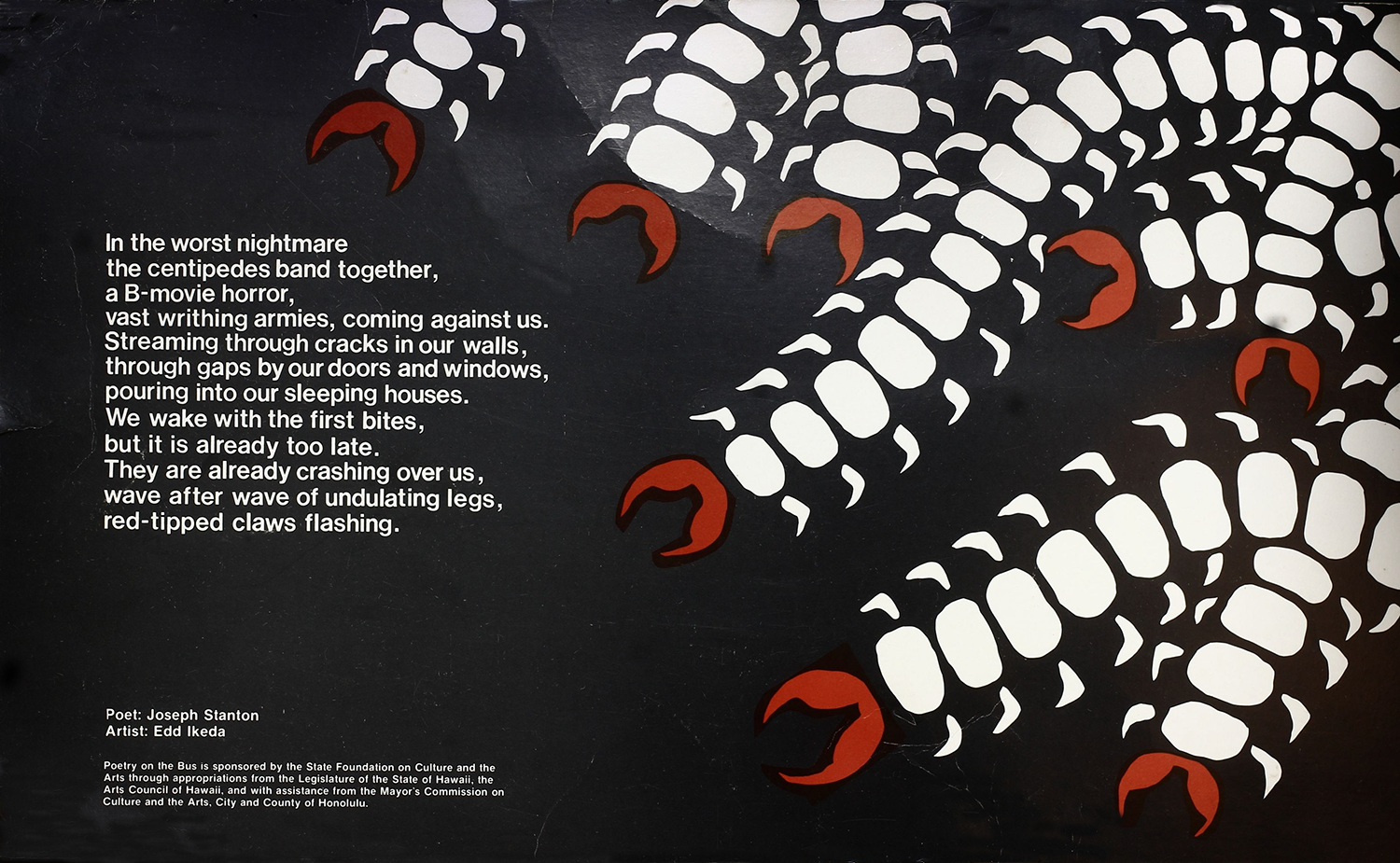
Courtesy of Edd Ikeda

Fujioka: Speaking of Hawai‘i’s wildlife, let’s segue to your longtime interests in the flora and fauna of Hawai‘i. What was the motivation behind your 2006 book A Field Guide to the Wildlife of Suburban O‘ahu?

Stanton: I was finding myself fascinated by the natural world. Channeling my excitement about the things around me in Hawai‘i, I began to write poems on the trees, birds, insects, animals, and so forth. The flora and fauna of Hawai‘i became a subject I wrote about very often in my poems. When I found that poems about such things were welcome at the various emerging local magazines, I began to submit pieces of that sort. Acceptances at various local magazines rewarded my excitement about the possibilities. In addition to my appearances in Bamboo Ridge, my poems began to come out in Michael McPherson’s Hapa, Loretta Petrie’s Chaminade Literary Review, and Pat Matsueda’s The Paper. I was also getting poems into journals outside of Hawai‘i, but, for the most part, I sent my nature poems to the local magazines we had here at that time. Of course, more often than not it was Bamboo Ridge where my nature poems appeared.

Fujioka: Can you share why you used “suburban” in the title of your 2006 book?

Stanton: At the time I was writing my poems about commonplace natural things—birds, insects, trees, and so forth—I was noticing that many other poets who wrote about nature in Hawai‘i tended to write about things in our state that they regard as exotic—sublime landscapes, lovely beaches, startling volcanic eruptions, and so forth. This was particularly true of visiting writers—the sorts of people that Tony Quagliano referred to as “travelling regionalists.” It seemed more important—for me at least—to write about the ordinary things we have around us every day. I was writing about particular living things and places that were amazing if looked at closely and thoughtfully but that were, in most respects, not at all spectacular. I dedicated myself to writing about geckos, mynah birds, toads, banana trees, and so forth. As a way to indicate that my poems were dedicated to the ordinary natural world of our wonderful island place, I decided to refer to my ongoing sequence of nature poems as “suburban.” It occurred to me that most of us who live on O‘ahu are living in the suburbs of the big city of Honolulu. I wanted to embrace the ordinary suburban nature of our world here as a key component of my Hawai‘i-inspired poems. Some of my Hawai‘i nature poems were recently re-published in Vice-Versa.

Fujioka: I enjoy reading your poems written in collaboration with artists. In what ways have you engaged with visual artists? What comes together during the collaboration process?

Stanton: Since the late 1980s I have often participated in an art exhibition at Ho‘omaluhia Gardens that we call “Aloha Ho‘omaluhia.” Most years, that exhibition is in place for the month of May. Some years I have collaborated with visual artists to make a few broadsides to display at that exhibition. I often, also, present a brief poetry reading at the opening reception for that art show. It is exciting to share nature poems amidst artworks by that group of outstanding artists. I have also often collaborated with the artist Adam LeBlanc. For those collaborations, Adam and I talk at length about his artworks and then I endeavor to write poems that parallel what is going on in the visual work. When we display the poems next to the artworks, an interesting conversation takes place between the images and the words. The artworks and the poems present worlds that are parallel and intimately interinvolved; but, of course, not entirely the same. Our first collaboration of that sort was an exhibition of light boxes by Adam that he called Conjuring Heroes. Adam was given a solo show in 1994 at the Koa Gallery at Kapi‘olani Community College to exhibit those works. For that show I composed a sequence of poems. My poems address ideas and imagery suggested by each light box. The contents of each poem were heavily influenced by my conversations with Adam. I printed my poems in large type, and each poem was shown on the wall next to the light box it endeavored to evoke. I published that sequence of poems in Chaminade Literary Review and subsequently included it in my 1999 book Imaginary Museum. Two other sequences of my poems inspired by the works of Adam LeBlanc have been displayed on the walls for exhibitions of his work. Those more recent poems were included in my 2022 book Prevailing Winds. One of those sequences gave the book its title. My most exciting collaboration with Adam involved a multi-dimensional work of his called Nights on B Street.
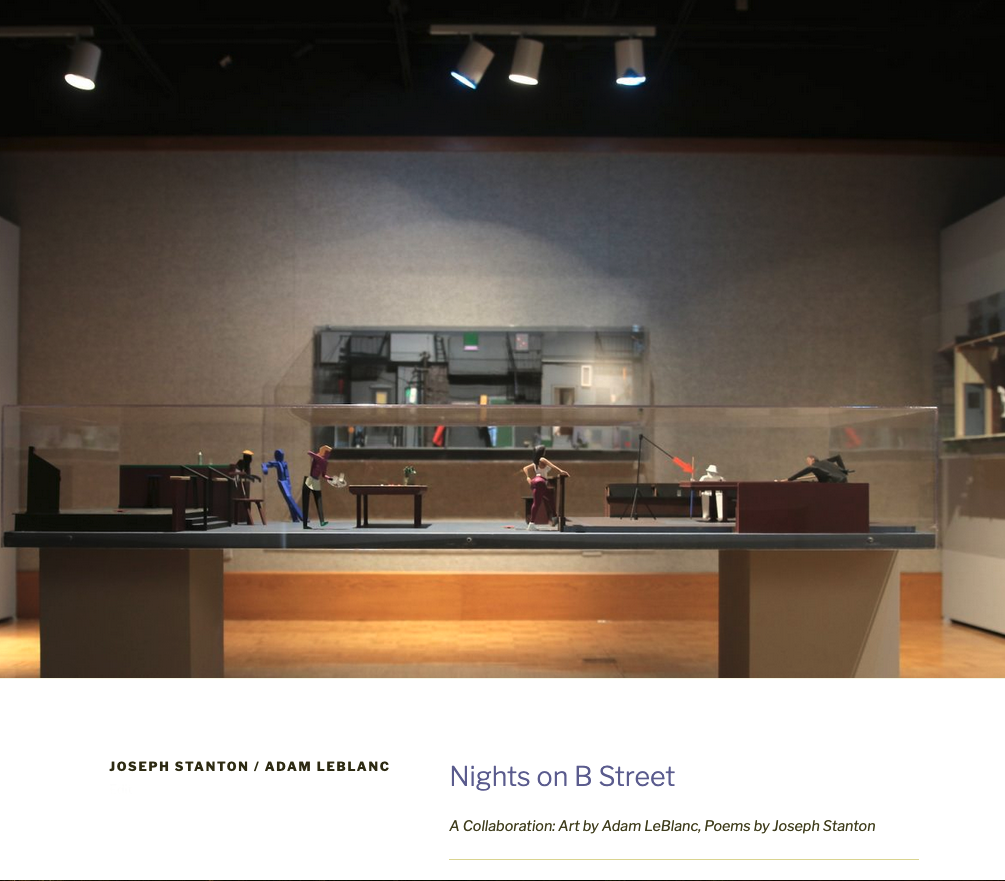
Fujioka: How did you and Adam LeBlanc develop your Nights on B Street collaboration?

Stanton: Nights on B Street is a work LeBlanc created—in its original, non-collaborative, version—in 1993. The seven detailed urban scenes were inspired by LeBlanc’s experiences and observations in various cities, but he had in mind primarily New York City and Boston, the Eastern cities where he had spent the most time. Nights on B Street was exhibited at the Linekona Gallery and was widely praised. I admired the show and often talked about it with Adam from time to time. When an opportunity arose for him to re-exhibit that show at Gallery Iolani at Windward Community College, Adam invited me to write poems that would parallel his pieces. Unfortunately, our Nights on B Street exhibition was installed in 2020 during the covid pandemic. We were not allowed to stage an opening for the exhibition, and only students and staff of Windward CC were allowed to see the show. Luckily, Gallery Iolani was able to make a video about that exhibition, which is still available online. Also, Pat Matsueda did a beautiful job of capturing details of that show in an article for the online journal Vice-Versa. It is good that our 2020 exhibition has been given an extended life in digital form. I am happy, too, that I was able to include my Nights on B Street sequence in Prevailing Winds. I was also able to include poems inspired by two of the paintings of Hawai‘i artist Kloe Kang in that book. Among other local artists, whose works inspired poems by me, are Ka-Ning Fong, Reuben Tam, Joseph Feher, Noreen Naughton, and Laura Ruby. My tenth book of poems, Stilled Lives, which is forthcoming in 2026, will contain more poems inspired by Hawai‘i artists.

Fujioka: Some of your nature poems in Prevailing Winds focus on extinct and endangered birds. What was the catalyst for those pieces?

Stanton: My poems on birds of that sort arose, in part, out of my efforts for the Aloha Ho‘omaluhia exhibitions. Many of the artists in that group are deeply committed to environmental causes. The influence of their interests inspired me to extensively research extinct and endangered Hawai‘i wildlife. Hawai‘i has a great many unique species. The onslaughts of development have impacted Hawai‘i so heavily that a large number of our unique species have gone extinct or are in danger of doing so. Over the years, I kept writing more and more poems about the difficult or impossible situations of Hawai‘i’s lost and at-risk birds. I include a number of those poems in Prevailing Winds. There is a sequence of poems on extinct and endangered Honeycreepers. A poem in that book that has gotten a particularly strong reaction at my poetry readings is “The Last Kauai ‘Ō‘ō,” which regards a particularly haunting extinction. There is, for me, an urgency about these poems. It has been suggested that Hawai‘i has experienced more extinctions of native species per square mile than any other place on earth.

Fujioka: What is your process when you are working on a nature poem?

Stanton: My process often involves a huge amount of research. Most of the research does not get used in the poem. The excess research I do for my poems inspired by artworks has always been useful to my day job as a teacher of art history. The research I do on the flora and fauna of Hawai‘i, however, is purely for the pleasure of trying to understand the world around me. I enjoy trying to be as knowledgeable about such things as I can. Once I have done whatever research I can manage to do, I move to the brainstorming stage. I play with ideas on paper or on my computer. Sometimes those brainstormings lead me to rough drafts for poems. From a rough draft, I move into the rewriting and revision stages. Sometimes I find my way towards a draft of a poem that might be viable; then it is just a matter of revision after revision. 

Fujioka: What is going on with your recent books and works in progress?

Stanton: I have been very fortunate in recent years. Several books of my art-inspired poetry have found their way to publication. Things Seen was brought out by Brick Road Poetry Press in 2016; then my next four books were published by Shanti Arts—Moving Pictures (2019), Prevailing Winds (2022), Lifelines: Poems for Winslow Homer and Edward Hopper (2023), and Kaaterskill Clove (2025). Shanti Arts is an independent publisher of fine books located in Maine. Shanti Arts beautifully designs each book and includes full-color reproductions of many of the artworks on pages facing the poems. My tenth book of poems, Stilled Lives, will also be published by Shanti Arts in 2026. As mentioned previously, Prevailing Winds contains many Hawai‘i nature poems as well as an array of art-inspired pieces. Although poems about paintings dominate many of my “ekphrastic” books, there are also, in those books, poems that respond to Noh plays, fairy tales, sculptures, poems, and movies. 

Fujioka: Joseph, what a pleasure and a privilege to conduct this interview. Thank you so much again for joining us to celebrate national poetry month. I appreciate your taking time from your busy schedule to meet with me. I look forward to reading your new collection.

Links:

Seven Poems in Vice-Versa
https://www.hawaii.edu/vice-versa/joseph-stanton-2024/

Video of Nights on B Street
https://www.youtube.com/watch?v=cWwni__EwS8
No Longer Furious or Shy

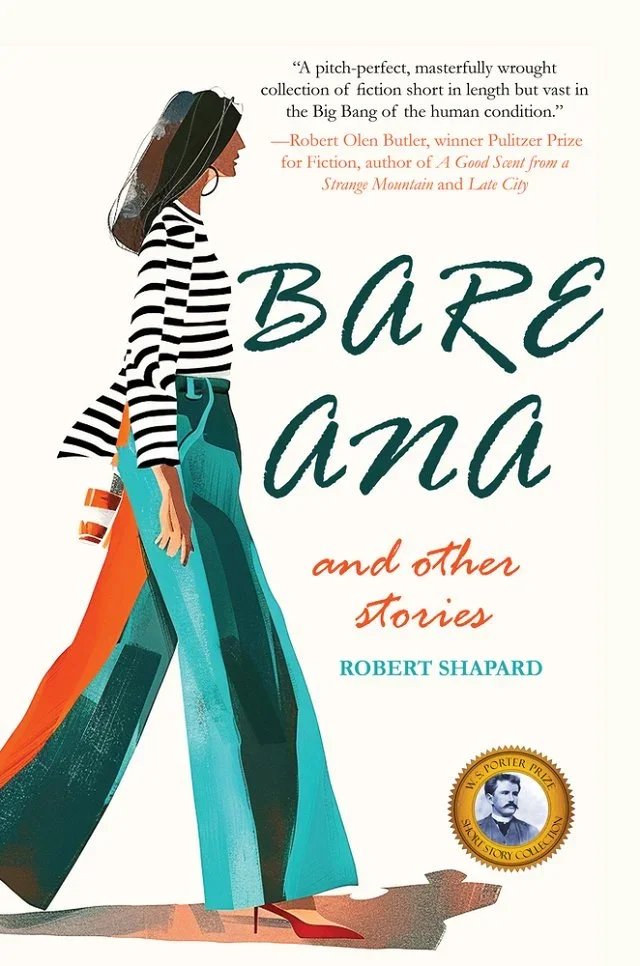
This interview with Robert Shapard was conducted after the publication of his volume Bare Ana and Other Stories, described by novelist Steve Heller as “finely crafted stories [in which] Shapard’s clear and insightful vision of humanity shines through.” Shapard “proves himself to be not only an accomplished editor but a master practitioner of the shortest prose forms. Most of these narratives end with a subtle manipulation of point of view that turns the reader’s perspective to a different angle.”

Do you try to keep friends, family, and acquaintances from appearing in your work? Why or why not?

I don't keep friends, family, and acquaintances out of my stories. They're everywhere, I just don't give them their "real life" names. Isn't that a rule of fiction? Maybe not as much as it used to be.

But I mess with real-life people, use parts of them, mix them up. In the story "At the Back Door," the real friend I modeled the protagonist on never repossessed a car. He and the story-him were indeed champion swimmers and had a hundred jobs selling everything from real estate to BBQ sauce, as in the story. The real-life him went to my high school, and we were in Marine Corps boot camp together. A different real-life person did the death-defying back dive off a highway bridge.

The opening story of Bare Ana, "Thomas and Charlie," is almost exactly a real-life event. That's me in the back seat of the car, observing a wreck happening ahead. (My brother was there, too, but I got rid of him.) The driver of my car is less my father than my uncles; that's not exactly my mother either, though she did keep the water jug. 

About the story "Turtle Creek," everyone I've told the story to has looked startled and said, "That was my high school class." There is one non-fictional character in the collection, in the story "Best Boy"—it's Boris Karloff, the original Frankenstein's monster. Though of course the scene is all fictional. 

Now that I think of it, most of my stories have no friends or family in them and are totally made up. Yet I feel that everyone I've ever known is in all the stories. 

I have gotten old enough to be the person I longed to be when I was young. How do you feel about getting older?

I think I've gotten to be the person I didn't know I wanted to be when I was young. As a youth I wanted to box in the Golden Gloves. I wasn't afraid to get hit. Indeed I got knocked out on my feet, once, in a backyard fight. The world was black for several long seconds as a stood there. When my vision came back, my opponent was standing there and I went at him in a fury until he cried quits.

But when I actually went to a Golden Gloves tournament (not as a contestant) for the first time, just the idea of being surrounded by a crowd in the super bright lights of the ring gave me a terrible stage fright, and I gave up my boxing ambitions.

Now I no longer get furious or shy, though I’m still full of contradictions. Aren't many of us? To answer your question (at last), I've wondered who I might be if I were one character in the collection. My guess would be the young husband in the title story, "Bare Ana." He's clueless about some things while discovering dragons in the sunset.

There are tinctures of irony and bitterness in your stories. Can you say what personal or professional experiences these represent? Or are they wholly invented?

I think irony was a family trait. Each of us, my brother, cousins, parents, grandparents, all living in the same house, had our own brand. My engineer grandfather was the boss, a skeptic who delivered ironies in one liners, with a laugh like a punch. My grandmother led the march for women's right to vote in our town, bet on horses (the bookie came to the door at dinner), and spoke her ironies in proverbs, like "Birds of a feather flock together." Birds could include any group such as idiots. But she was forgiving of human frailty and was by nature wise, kind, and generous, and everyone loved her.

My ironies were weird. I liked to draw cartoons. One was a huge fat mobster man in an overcoat wearing a homburg carrying a whip. He stood on a flat, wheeled cart apparently pulled by a dog. But the dog wasn't pulling. She was in a harness but lying on her side, suckling her newborn puppies, giving the fat man a pleading look. A dialogue bubble for the fat man said, "Damn dog." I have no idea what it meant. I just thought it was hilarious. I showed the cartoon to my mother, who gave me an uneasy glance, like My child is disturbed. But, always encouraging, her words were something like "My, how interesting."

None of us was bitter about anything, except my father, late in life. He was a great guy, but had become an alcoholic, precipitated by medical problems. He tried to commit suicide several times and finally succeeded. This is the story "Dummy," which is my oldest story in Bare Ana. The event depicted in the story happened just a year before I became a student in a writing program. I'd come late to fiction and was still trying to figure basics out. I remember reading Donald Barthelme's The Dead Father, which was recent, though now called a classic of postmodernism. I couldn't figure it out. But it may have prompted me to write about my father's suicide. What I really wanted to know was how you translate real life to fiction. I applied fiction techniques, such as images and dialogue, to memory, trying to capture a true event of an afternoon.

But a strange thing happened. The story took over. It demanded (that is, ideas kept insisting) that my father die at the end. In truth it was just one of my father's suicide attempts. (In real life he was up and walking around the next day, arm bandaged, having a drink.) Yet rereading, now, I see everything in the story led to his death. And the story, to be honest, convincing, and true to itself, wanted to deliver. So I wrote an additional truth, for my narrator. He didn't want his father to be dead, so his mind created an additional reality. And the story couldn't argue, because after all this reality could be true as well. So the father was dead and not.

Later I sent the story to a magazine, Fiction International, where, they told me, it created an argument among the editors about what fiction should be. Anyway they published it. In real life, I did finally discover my father's dead body, in a car in a sealed, smoky garage. It was carbon monoxide that got him. The car was still running. A slightly different set of police from the ones in the story came.

Does aging affect what you write or how you write?

William Butler Yeats said, "An aged man is but a paltry thing, a tattered coat upon a stick." I see a lot of them in the café of our Whole Foods grocery afternoons as I take my place among them. Often they're wearing REI hiking gear and Kizik step-in shoes. As I unfold my laptop, I don't feel old, not any older than the Internet. It's true the other day I got irritated at forgetting my great aunt Lowe's husband's name. But in a minute I remembered Uncle Arthur! With his vicious chihuahua, Pepe. God bless them, they haven't changed in sixty years. 

But my writing has changed. I grew up with no sisters and barely knew any girls. All the pets were male! So when I started writing stories, they were all from a male point of view. If I tried to add a female point of view, female readers would give me a look and say, "Weird." But I kept trying. I liked discovering things from the women's side. Eventually I realized the woman and the girls had always known everything. Now, in my second childhood, I'm writing a novel about a twenty-year-old boy, or man. Maybe male readers will say "weird." Were I W.B. Yeats, I might reply, "Soul clap its hands and sing, and louder sing / For every tatter in its mortal dress."

Close to the Wind

Human-shaped, monkey-loving, robot-fighting, pirate-hearted, storytelling junkie, Mark A. Rayner is an award-winning author and playwright. His short fiction has appeared in, among other distinguished publications, The Saturday Evening Post, Abyss & Apex, Paradox Magazine, and Corvus Review. A hybrid author, he has published five novels and two collections of short stories and has had several plays produced.

Rayner is also the co-host of Re-Creative, a podcast about the art that inspires creativity, and teaches digital production and theory at the Faculty of Information and Media Studies at Western University in Canada. He does all of these things while being Canadian and owning cats.

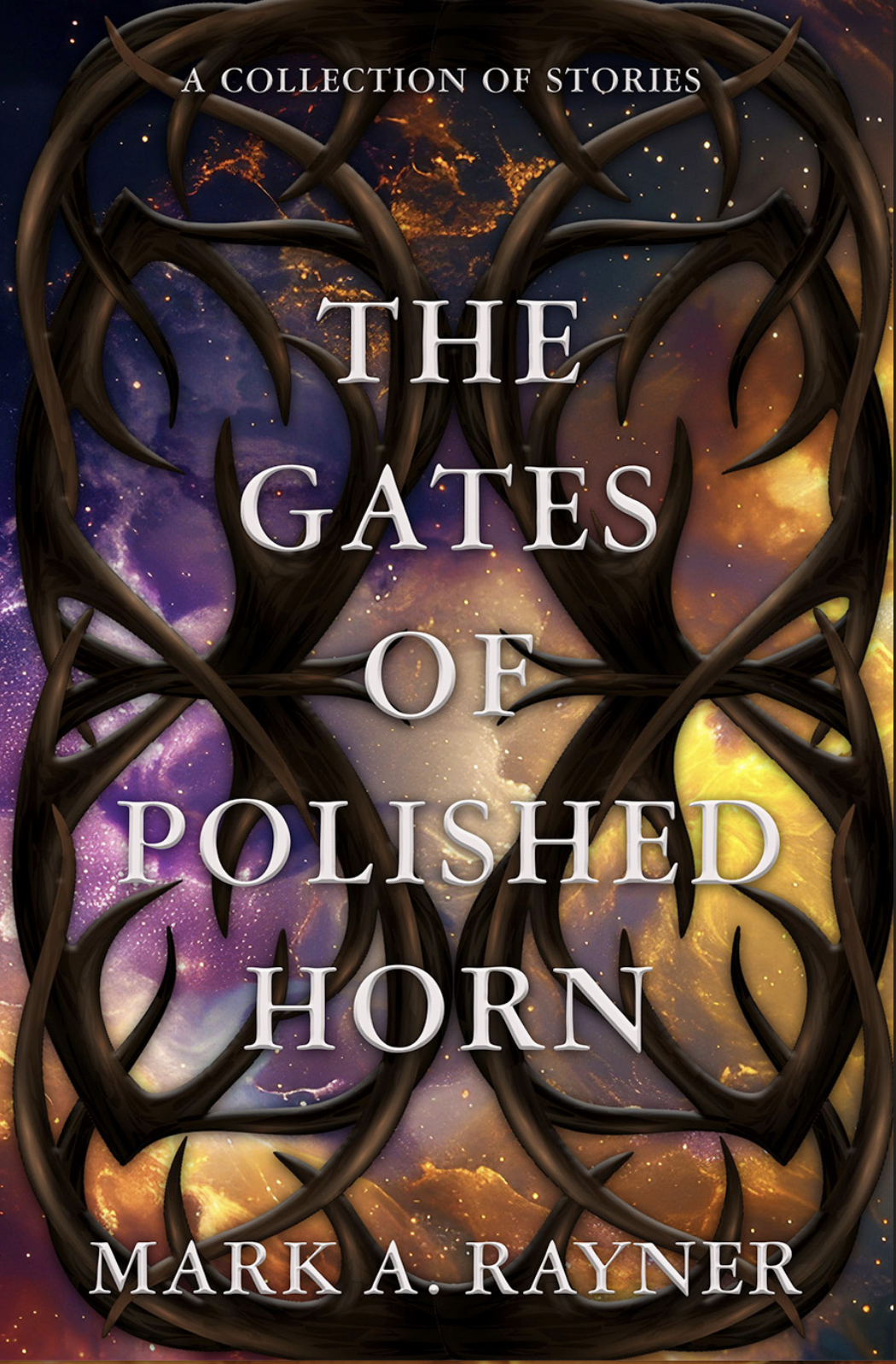
The short-story collection this interview focuses on.

Before I answer these excellent questions, there’s just one thing I want to say, which is that any answer the reader has for these is perfectly valid. I do believe that once the author is done writing, all the power flows from the reader. All the interpretation is the reader’s. Did I have intentions when writing these stories? Absolutely. Was I completely aware of all the implications of everything I wrote? I’d love to say that I was, but the reality is that the best writing I do is powered by my subconscious; my thinking brain may guide the ship—and it certainly has the hand on the wheel when I’m working on second and third drafts—but it doesn’t call all the shots. So, take these answers with a dollop of salt. 


The Real Primo

PAT The story begins with the narrator asserting, "Would you believe me if I told you Buddha had the set-up all wrong?" Is the set-up the idea of reincarnation or something else? What is the role of "no self" in this?

Primo's life is short and devoid of what we might call outstanding achievement. Yet you imbue him with enough humanity for us to care what happens in that short life. In fact, it is the ordinariness of his life that makes him a sympathetic character. The awful act performed by his "uncle" changes the quality of that ordinariness, however. What made you decide to make that change?

The last line of "The Real Primo" is "So when the crash came, there was no Primo. There was no--" I assume we are supposed to think that the narrator was correct about the Buddha having things wrong and is interrupted in the act of proving himself correct. Is that right, or is there a deeper paradox you are trying to create?

MARK All great questions! Here’s my interpretation of the story. Primo is encountering samsara, the Buddhist concept that there is a cycle of life and rebirth that all beings experience, but it’s not exactly the one Buddha described. It’s not a new body, a new life, it’s a recreation of his previous life. Perversely, in Buddha’s rebirth, we’d have a chance to make new decisions with a new life, but Primo is locked into the one—he can’t have an impact on what happened in his life because it already happened. This makes Primo a kind of non-entropic time traveller. So, the setup from Buddha is wrong, but the answer to Primo’s dilemma can be found in Buddha’s wisdom regardless. His second noble truth, if I can paraphrase, is that all suffering is caused by attachment. But attachment to what? 

He attempts to discover this. As you observe, he’s an ordinary human and that’s definitely something I wanted to explore. That includes the terrible things that happen to ordinary folks, as the intrusion by Primo’s “uncle” is. There is a recognition of this, but this doesn’t become the fact of his life that he’s attached to. Nor are his loves. Eventually, the hero discovers that it is attachment to the very idea that he exists. Once he realizes that he doesn’t, the story ends. Buddha was wrong about the setup but not the central insight. 

The Consolation of Victory

PAT This story has a wonderful self-reflexive moment: a professor says, "Were they lovers? Somehow the thought offended me, and I felt a sense of shame. I'd been living under the empire's rule my whole life—at least, what I could remember of my life—and I suddenly realized that I had absorbed their prejudices too." A professor also appears in "After the Internet." In response to an event or opportunity, each man does something to challenge the safe, sheltered life of the academic and to suggest his greater potential. Do you think there is something about academia that is inherently limiting?

MARK I really don’t think there is, and if anything, I believe it is the opposite. Professors have an incredibly privileged role in our world. Despite the vagaries of grading, committee meetings, and other bureaucratic annoyances, at the heart of it, professors get paid for researching the things that interest them and teaching students who want to hear about those things. But that freedom has a dark side too, which is that it’s easy to fall into the trap of protecting your own ideas to the denigration of others. It gets petty sometimes, even. The best academics have open minds, and for the most part, that is the experience I’ve had with my colleagues in the academy. If there is a limitation it is in specialization and expertise. My understanding of the perceptual set in psychology is that our expertise tends to bias us to see the world through that lens. But again, the best academics counter that with critical thinking, and really, aren’t we all challenged with our own biases?

Close to the Wind

PAT The idea of life being equal to what we remember of it appears in other stories, most notably in "Close to the Wind." In Sam Moriarty's struggle to remember who he is, how he lived and loved, he expresses, realizes his freedom as an individual. The equation of identity and freedom is characteristic of sci-fi writing, and here you add the wrinkle of Sam's trying to find his love, Linda. And yet that search ends in betrayal: “suddenly I find myself frozen within her arms. Her head cocks slowly to one side, machine-like, and her voice sounds wrong, speaking with a strange accent as it says, ‘We'll keep you safe, Sam. Safe here.’” Are we to think that just as Sam searches for himself, who he was, he continues his search for love? Though he is an artificial creation, the longer he searches and persists, the more human he becomes, the barriers to his forward movement helping to shape who he is.

MARK My original intentions for this story are really lost to me, as it’s one of the oldest pieces in the collection. It was the sequel to the first story I ever had professionally published, in fact. My recollection is that I wanted to explore what it was like to imbue an artificial creation with consciousness. What would that be like? In the prequel story, Sam has given the AI his memories in the form of journals, letters, recordings, video, and photos. In this story, the AI has incorporated those ephemera—and its previous encounter with Sam’s wife—into its developing consciousness. In a strange kind of way, this story is an echo of “The Real Primo,” which I wrote fifteen years later. Sam is trapped, just as Primo is trapped, in its desire—its attachment—to the idea that Linda is out there waiting for him. To the idea that it—Sam—exists. 

Website: markarayner.com
Re-Creative podcast: re-creative.ca

a wasp in flatland

This interview with Gary Mawyer follows the release of his book of epic short stories, Dark Trails, a re-release of a previous volume, Dark. It is also a continuation of “Supernatural Fiction Creates the Intruder,” an interview Lillian Howan did with Gary in which he memorably said,

I like the idea of familiar workaday worlds and nearly-indecipherable "other worlds" on adjacent tracks and sometimes crossing paths. This idea seems to me to correspond with experience and it's just a coincidence that it's also good for stories. Of course the very strange isn't confined to the deep woods. Cities and towns include corners or turnings that lead "off the map." Part of my hope for these stories is to convey the further idea that maplessness is OK. We need our maps. We perhaps cheat ourselves a little if we shy away from the map edges, though. The stories in Dark are meant to encourage and amuse, mainly. I don't mind an occasional chill. We need chills. But I see these tales as affirmations that the immense web of correspondences making up our worlds is deep, old, and strong, while our human maps of reality are cultural maps. 

We caught up with Gary as he hovered between dusk and evening, gazing into the stream of nearly forgotten moments and past deeds. As always, his answers to our feeble questions displayed uncanny abilities of wise enrapture and profound enchantment.


Feelings emerge from the heart and thoughts from the mind. Does this seem true for you?

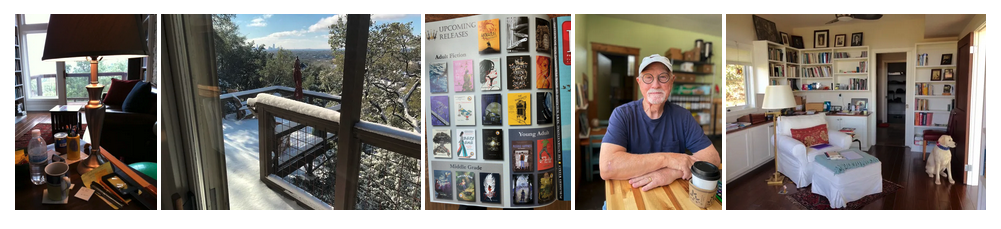
Edited in Photoshop, an old snapshot of Gary’s desk.

I struggle with that concept. Some of my favorite thoughts are feelings and some of my favorite feelings are thoughts. Maybe I’m quibbling, because I do feel some distinction between emotions and reasoning; a piece of music (for instance) might evoke what clearly seem to be feelings whereas a piece of historical writing may evoke narrative connections with other related histories. Thoughts quickly become narrative, and music seemingly does not. But music is mathematically constructed. Music’s emotive quality is a structure as orderly in some ways as language. Some of the apparent distinctions between feelings and thoughts may not hold up under closer examination.

Do you include friends, family and acquaintances in your work?

Yes and no. I don’t write about my family. I consider my family’s lives private. I consider friends and acquaintances fair game. Friends provided many of the elements for the stories in Dark Trails. Exemptions, likewise, was largely drawn from the experiences of friends as well as mine from 1969 to 1970.  It’s always been the case that some friends recognize their own experiences being quoted and others do not. Experience is subjective and angular. Many people take their own experiences too lightly to recognize them later. We do not always believe the things that happen to us.


Has aging affected your writing?

I’m not yet shockingly old. I’m only in my seventies. Even so, that was enough to see three or four distinct American sub-civilizations come and go. It’s enough to change anybody’s writing. In youth what I was doing had no ulterior purpose. The older stories in Dark Trails reflect that. They are stories of amazement.

In mid-life I wrote more seriously, with purpose or need. Shad River for instance was intentional—a social or societal novel. Every Shad River version, including the two Rockfish predecessors, was meant to affect the thought and beliefs of readers by the medium of the historical novel, addressing grandiose topics like race, sex, religion, war, the ideals of the American Revolution. The different versions reflect my changing theories of what might best put it over in a thirty-year project, forty if you count a lost set of short stories, “Ten Rockfish Tales.” A failure as the world goes and yet needed more than ever as the American empire collapses around us. I knew my part. Sometimes you have to stand alone. That’s one of the lessons of aging.

As Karen, my wife, told me after recent travel disasters, I’m not an adult anymore. I’m an elder. I’m officially old and my former purposes seem quaint. The follies of youth are a cliché, and the follies of maturity ought to be. We sit by the river of time as all the elements of the world we once knew float past. Eventually we ourselves float past, and as you watch yourself disappearing downstream around a distant bend in the river, you can only ask where that supposedly leaves you in time and space. Attempts to answer that question, with the help of my co-author Edward Mawyer, led to the world of Macaque as described in The Adventures of Reese Macaque, Private Investigator. The future remains by far the most interesting thing, as it always was.

Personal and professional experiences: are there tinctures of irony and bitterness in your writing, or are these invented?

They’re invented. I’m incapable of irony.

Seriously, irony seems to be part of the structure of reality. I’ve been extremely lucky, personally and professionally, but the people around me have always graciously provided a wild zoo of misadventure. Professional environments are particularly rich in brick-wall stupidity, goofiness, and surreal experiences. The bitterness of others is great material because people like schadenfreude; even very kind and compassionate people smile at the schadenfreude of others.

Other people’s mishaps added to the Dark Trails stories throughout. Dark Trails includes stories set in the 1970s or as recent as a few months ago. They all include unexpected happenings and uninvited meetings with questionable consequences. I’ve been fascinated with such things for fifty years.

The unanticipated outcome, or reversal of expectations, is also the mainspring of comic writing and even of the humble yet majestic language entity, the joke. As Dorothy Sayers observed in the foreword to her immortal 1929 short-story omnibus, the line is very faint between tales of crime and detection and tales of horror and the supernatural. The line is just as faint between horror/supernatural tales and comedies, both requiring unanticipated outcomes or reversals of expectations, one of the definitions of what constitutes a joke. I emphatically see myself as a comic writer, but the stories in Dark Trails are natural crossovers into tales of the uncanny.

My comic novels also describe unexpected meetings and questionable outcomes. I mentioned Exemptions, about the perils of hanging out with the very best of the wrong people, and The Adventures of Reese Macaque scarcely needs to be spelled out in this context. The Southern Skylark also has mishap as its practical subject, a topography of unfortunate outcomes across which the protagonists struggle from one spot of bad luck to the next, like an Irish novel. Suppose life was like that. It’s something to think about.

Among the things you have pursued—books, antiques, mosaics, painting—is there anything that leaves you unfulfilled?

In 1983, as a freshly minted MFA looking for a job, I had had three years’ experience as a proofreader at the old Michie Company Law Publishers, reading state and city codes and court reports, and a year as a Hoyns Fellow writing footnotes in the basement of the Alderman Library. I wound up at the Urology Department in the Medical School, redacting the Investigative Section of The Journal of Urology, the pre-eminent international journal in the field. Redacting is the term medical editors used in those days for what would now be called page editing. The MFA was still regarded in those early days as a potential teaching degree, so I had no reason to think I would stay long at Urology. Little did I know I would still be doing incidental copy for the Journal of Urology thirty-plus years later and ultimately retire from the department.

In between I worked for other journals, including stints as the Managing Editor of the tiny but prestigious World Journal of Urology, Editor of the Virginia Transportation Research Council, Executive Secretary of the Wound, Ostomy and Continence Nurses Society, and Managing Editor of JWOCN as my last gig before retirement.  I also edited books, including the annual Year Book of Urology and the massive Adult and Pediatric Urology, faculty publications, and an incalculable number of grant applications. I developed a career on the side in freelance medical editing, primarily for Japanese, Chinese, and Taiwanese clients. My specialty ultimately became molecular biology, and I still have a couple of clients even now.

Dover, my father, was not a rich man and had a severe addiction to antiques and art objects. It manifested while I was still an infant. The only way he could handle the treasures he craved was to acquire them for resale. I was indoctrinated into the world of looking for antiques before I was old enough to know where I was. As a child I sold Cokes for a nickel apiece out of an ice bucket at country auctions where Dover clerked for the auctioneer. I grew up surrounded by art and antiques, though nearly all of it was destined to be sold promptly to provide Dover funds for more antiques. It was a good apprenticeship in art and artifacts.

Dover was also a painter, self-taught, who frequently drove to the National Gallery in D.C. to look at the brushwork of the old masters. I always went along. At home, while Dover painted, I would sit across the room at a tin TV tray and paint little childish landscapes of my own as Dad talked about his beliefs and his artistic prejudices. Dover had as many artistic prejudices as Ruskin. Strangely, though his painting was immaculate, he ceased to paint and began a career on the side restoring paintings. He expertly repaired many a battered old oil.

I kept painting for several years—my expectations were much lower. Married, Karen and I lived in small apartments, and when the kids began to arrive, the messiness and toxicity made painting impractical. I painted whimseys from time to time, including three of the four walls of a kid’s bedroom—one of my more concerted efforts. Decades passed and I continued to hoard paint and painting supplies. Now I’m back with a big pile of supplies. Weirdly, though, assemblages in glass, tile, shell, and crystal are what come out, not paintings. Maybe mosaics—I can’t say. I foresee ending where I began, in oils. My goal is fun and I’m enjoying this hugely.

You are a fan of Japanese Art.

Yes, I am an outright anime fan. I’m also a big fan of Japanese woodblock prints, a tradition that led me straight to anime. Japanese art traditions treat light, shadow, and color somewhat differently from western traditions. Western artists were startled by the boldness and freedom of Japanese coloration when the first Japanese woodblocks reached the west. The same happy freedom with color is vividly alive in anime.

A question in all painting is “where is the light coming from?” Old art in the West often has the same shadowless background field that much Japanese art retained into modern times. Later, as Western art developed an obsession with naturalistic perspective, light and shade became things the painter needed to define. Traditional western painting includes a point where illumination originates, and the shading in the painting follows naturalistically. By comparison the woodblock and sumi-e traditions preserved “the light of eternity,” which does not cast shadows. If a shadow appears, it too is objective, rather than an absence or diminution of light. Indeed, in woodblock prints, buildings may be shown from a high angle as roofless interiors, so the inside and outside can be viewed simultaneously.

When twentieth-century western painting, particularly in the abstract schools, returned to shadowless light or the treatment of shadows as things, this was in some measure the result of contact with Japanese art, but it wasn’t new. Giotto, for instance, painted shadowless light. In Japan, experiments with luminous suffusion, where the subject platonically provides its own light, continue very freely in the cultural mainstream, for instance Takashi Murakami’s Superflat school, Kaikai Kiki, and anime. Superflat also hints at another potential light source inside paintings: the viewer. If the viewer is the source of the light, the shadows are hidden. I think I’ll just risk saying that the esthetic of shadows and negative space in Japanese art is a thing unto itself.

Please say something about the effect of your professional work on your writing.

Another tough question. My feelings about this are complex. I spent over thirty years in medical editing, and I still have private clients though I retired ten years ago. In 1983, as a freshly minted MFA looking for a job, I joined the Urology Department in the UVA Medical School, redacting the Investigative Section of The Journal of Urology. Soon I was producing a column on scientific writing, “Investigative Grammar” (recently scooped up along with the rest of my work by Anthropologie without compensation as part of the training of their AI language model). I saw an era of medical revolution, from lithotripsy and Viagra to evidence-based medicine, laparoscopy, and robotic surgery, tremendous advances in the study of hormonally controlled cancers, and the birth of molecular biology. I could never walk away. Journal work included stints as Managing Editor of the tiny but prestigious World Journal of Urology, an interlude in engineering as Editor of the Virginia Transportation Research Council, and a return to Investigative Urology. My last long gig before retirement was Managing Editor of the Journal of Wound, Ostomy and Continence Nursing. Aside from journal work, a textbook avalanche included the annual Year Book of Urology, the massive Adult and Pediatric Urology, and numerous other titles along with my own growing side career of freelance papers and grants. I never intended for any of this to happen. Hope I’m not quoting Jack the Ripper when I say that.

What affected my literary writing: international exposure to many editors and science writers, some good, some bad, and some terrible. I worked with authentically great editors. I may have learned just as much from the absolute worst. My job provided continuous intellectual stimulation—at least a few new things every day—and the gratification of seeing clinical and research changes take root and grow, affecting the lives of whole categories of patients. It was fun to watch young researchers begin as postdocs and wind up as professors and lab heads. There wasn’t nearly enough time to fit everything in. Only Plutarchan levels of discipline made all this possible. Come to think of it, I had a wonderful career.

The effect on my writing: you know my books, and you also know I write by redrafting, so each book fronts for much more than its weight in backstory. On the career side, everything I touched bloomed. I had nothing I needed to ask for. A bee is a hairy stinging insect whose food and shelter inadvertently produce what Jonathan Swift called sweetness and light. The effect of medical editing on my writing—my final answer—food and shelter, but not without sweetness and light. Then I retired and was finally able to stop being a bee and become what I always wanted to be—a solitary wasp.

Photograph by Alan Mawyer. More of Alan’s photography can be found at Vice-Versa.

Reflections

A secular pilgrimage

Alok Bhalla

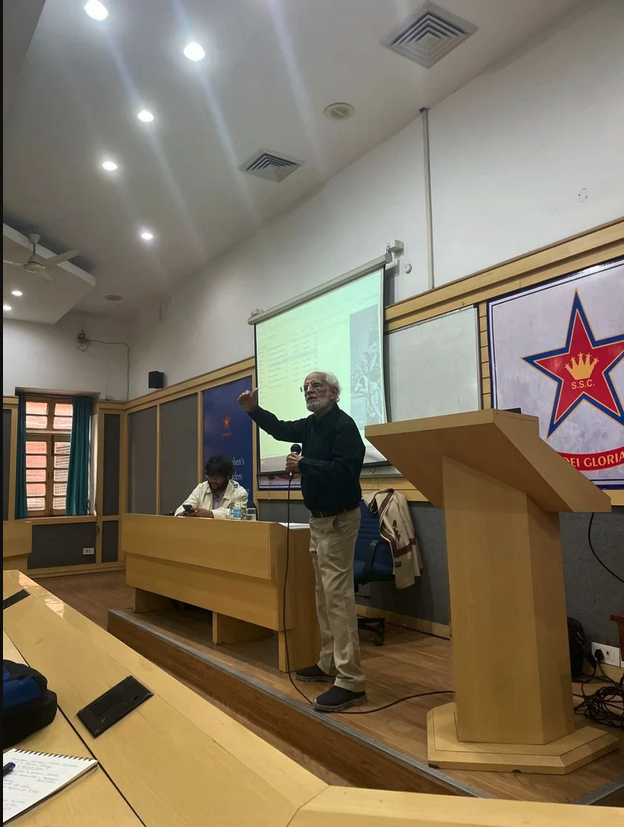
In November 2022, the eminent translator, editor, and writer Alok Bhalla gave a lecture on attending St. Stephen's College, in Delhi, in the days following British colonialism and the 1947 partition of the Indian subcontinent. What follows is Bhalla’s reflection on that lecture and its significance not only to the students but also to himself.

Two days ago, I gave a talk on the Partition of India at my old college, St. Stephen's, and talked a little about Intizar Husain. I usually don't agree to give talks or go to seminars these days. Lectures now seem a bit narcissistic and seminars tend to send me to sleep (partly out of boredom, but mainly because I can barely hear). But I couldn't refuse an invitation from undergraduate students (not teachers and scholars) from an Institute to which I owe a great deal.

I told the students, who no longer remember the College's history as a truly secular place, that my father had started teaching in a Christian Institute in the years before the partition after having studied in Lahore (Pakistan) a decade prior to the partition. They had not been told that Gandhi used to stay at the house of the College's first Indian and Christian Principal and that Tagore had composed the first draft of his Nobel Prize–winning poems, Gitanjali, in the Principal's house.

It was also important for me, as a person who had grown up on the campus of the college, to acknowledge that it was in the college library that I had stumbled upon the diaries of someone called Simone Weil. I had not the foggiest idea of who she was, but I made some notes about what she had said about the nature of violence—notes that I have carried with me ever since. Some of them were prefixed to my first books on the Gothic novel, some to my different essays on the partition, and, most recently, some to my five-volume work on the Gita and the Mahabharata (entirely inflected by Weil and Gandhi and the Bible—a sort of cosmopolitan placing that will not win me new friends in the present times in India).

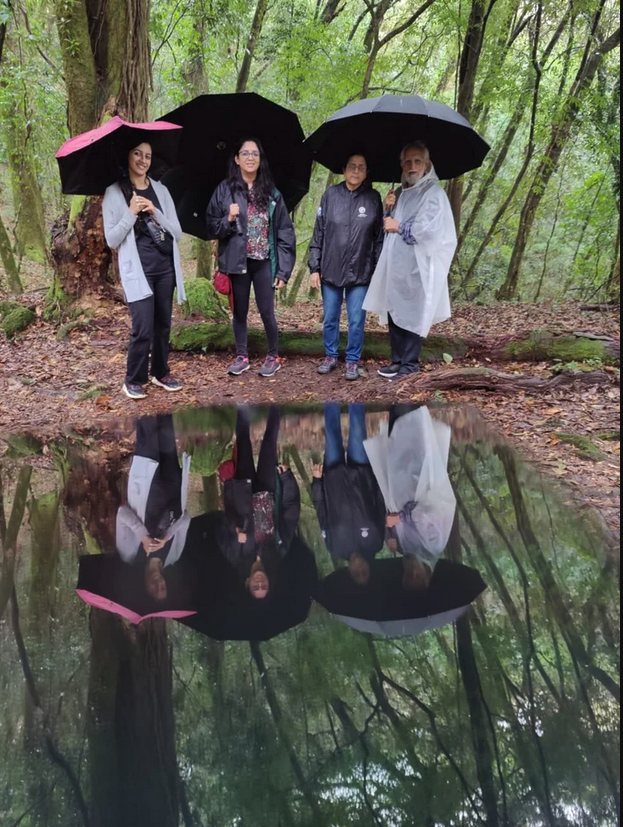
This is a recent photograph of me and my small family taken in the sacred forest near Shillong, where we happened to be last month. Our young Khasi guide was very pleased to make us pose with our reflections in a puddle of rain water! The local villagers look after the forest and tell every visitor that a curse will fall on anyone who takes even a twig or a leaf out of the forest. Visitors are welcome, however, to leave their footprints behind!

As I spoke informally to the students, I felt a sense of completion, a satisfaction that comes with the feeling that I had done all that I could have. Now I could look back without too much anxiety and say to myself that the long journey that began in the corridors of this college and took me to the other side of the earth has been fulfilling (and far luckier) than I have a right to expect (there being people worthier than me who deserved more). So at one end of the journey was St. Stephen's College and at the other a return to the College—a sort of secular pilgrimage (if secular really means of this earth and in this time).