

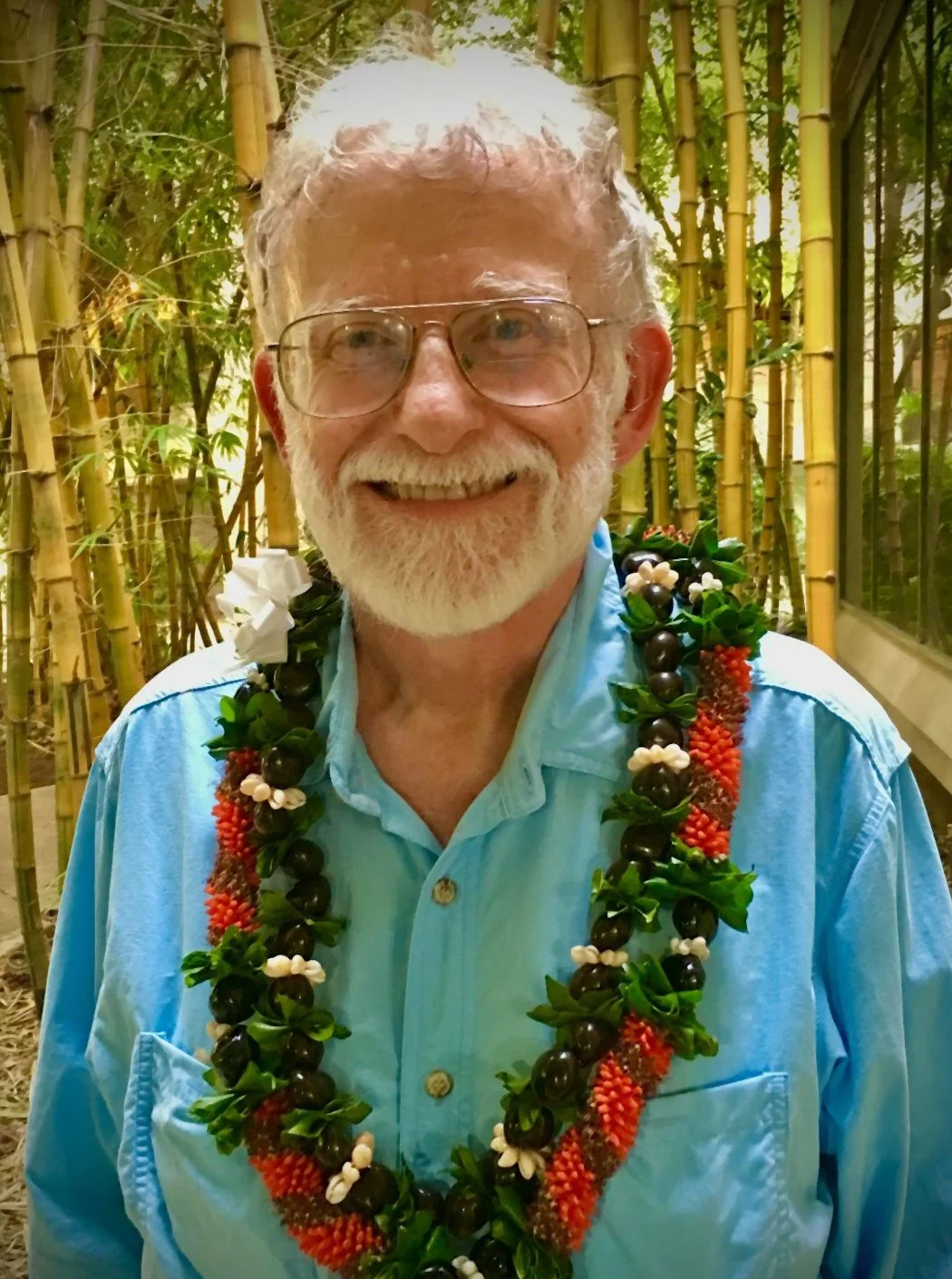
Joseph Stanton has published nine books of poems—A Field Guide to the Wildlife of Suburban Oʻahu, Prevailing Winds, Lifelines, Kaaterskill Clove, Moving Pictures, Things Seen, Cardinal Points, Imaginary Museum, and What the Kite Thinks. His other books include Looking for Edward Gorey and The Important Books: Children’s Picture Books as Art and Literature. His poems and essays have appeared in Poetry, Harvard Review, New Letters, Bamboo Ridge, Art Criticism, American Art, Journal of American Culture, and elsewhere. He has collaborated with artists and musicians and has received numerous awards for his work, including the Tony Quagliano International Poetry Award, the Cades Award for Literature, and the Ekphrasis Prize. For many years, he taught art history and American studies at the University of Hawaiʻi at Mānoa, where he is now Professor Emeritus.
Interviewer Midori Fujioka is a teacher, writer, and calligraphic artist and serves as editor of Vice-Versa, a University of Hawai‘i e-zine. She attended Scripps College, Waseda University in Japan, UCLA, UC Berkeley, Bread Loaf School of English, Institute of American Indian Arts, and University of Hawai‘i at Mānoa. The Djerassi Resident Artist Program features her work.
Fujioka: Professor Stanton, welcome to Auteur Limits. Thank you so much for joining us to celebrate National Poetry Month, the largest literary celebration worldwide. May I please call you Joe?
Stanton: Sure.
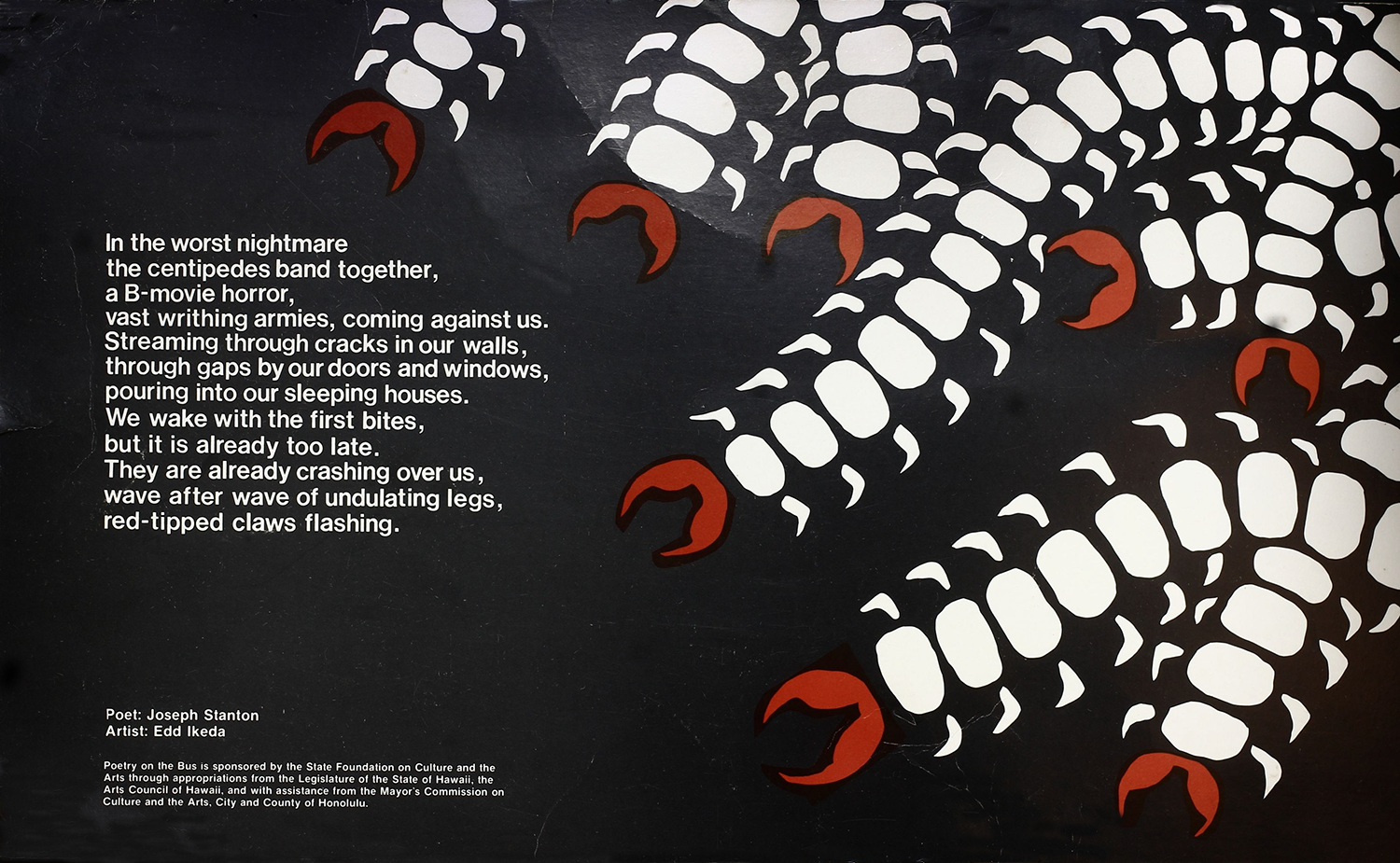
Fujioka: Let’s start the interview with how we met at the Poets House in NYC. But before that, I have a confession to share because I admired your poem “Centipedes” on TheBus in the 1980s. If I remember correctly, I saw it on the 1L Waialae from Kaimuki to University during the UH summer sessions. The poem resonated because my brother had been bitten by a huge centipede at Grandma’s house when we were kids. Since I am attracted to Japanese things, the artwork and minimalist colors reminded me of woodblock prints. Can you please speak about the inspiration for this poem, your collaboration with Edd Ikeda, and a sponsorship by the Mayor’s Office on Culture and Arts?
Stanton: In the late 1980s, Elaine Murphy, who was the arts director for the City of Honolulu, got the idea that it would be exciting to have a bus-poster contest, which she called “Poetry on the Bus.” In some cases, individuals submitted entries in which they created both the poetry and the graphics. Joe Balaz, working alone, created a very funny poster that became very popular. In other cases, artists and writers collaborated. The husband-wife team of Tony Quagliano and Laura Ruby were frequent winners. The contest ran for several years. In 1987, I decided to ask the talented artist Edd Ikeda to collaborate with me. We decided to use a short excerpt from my long poem “Centipedes,” a piece that had originally appeared in Eric Chock and Darrell Lum's Bamboo Ridge. In the poster, Edd’s stylized swarm of centipedes attacks the words of my poem. I still have a copy of the poster, which I sometimes hold in front of me at poetry readings while reading the poem. I subsequently included that poem in my Field Guide.
Courtesy of Edd Ikeda
Fujioka: Speaking of Hawai‘i’s wildlife, let’s segue to your longtime interests in the flora and fauna of Hawai‘i. What was the motivation behind your 2006 book A Field Guide to the Wildlife of Suburban O‘ahu?
Stanton: I was finding myself fascinated by the natural world. Channeling my excitement about the things around me in Hawai‘i, I began to write poems on the trees, birds, insects, animals, and so forth. The flora and fauna of Hawai‘i became a subject I wrote about very often in my poems. When I found that poems about such things were welcome at the various emerging local magazines, I began to submit pieces of that sort. Acceptances at various local magazines rewarded my excitement about the possibilities. In addition to my appearances in Bamboo Ridge, my poems began to come out in Michael McPherson’s Hapa, Loretta Petrie’s Chaminade Literary Review, and Pat Matsueda’s The Paper. I was also getting poems into journals outside of Hawai‘i, but, for the most part, I sent my nature poems to the local magazines we had here at that time. Of course, more often than not it was Bamboo Ridge where my nature poems appeared.
Fujioka: Can you share why you used “suburban” in the title of your 2006 book?
Stanton: At the time I was writing my poems about commonplace natural things—birds, insects, trees, and so forth—I was noticing that many other poets who wrote about nature in Hawai‘i tended to write about things in our state that they regard as exotic—sublime landscapes, lovely beaches, startling volcanic eruptions, and so forth. This was particularly true of visiting writers—the sorts of people that Tony Quagliano referred to as “travelling regionalists.” It seemed more important—for me at least—to write about the ordinary things we have around us every day. I was writing about particular living things and places that were amazing if looked at closely and thoughtfully but that were, in most respects, not at all spectacular. I dedicated myself to writing about geckos, mynah birds, toads, banana trees, and so forth. As a way to indicate that my poems were dedicated to the ordinary natural world of our wonderful island place, I decided to refer to my ongoing sequence of nature poems as “suburban.” It occurred to me that most of us who live on O‘ahu are living in the suburbs of the big city of Honolulu. I wanted to embrace the ordinary suburban nature of our world here as a key component of my Hawai‘i-inspired poems. Some of my Hawai‘i nature poems were recently re-published in Vice-Versa.
Fujioka: I enjoy reading your poems written in collaboration with artists. In what ways have you engaged with visual artists? What comes together during the collaboration process?
Stanton: Since the late 1980s I have often participated in an art exhibition at Ho‘omaluhia Gardens that we call “Aloha Ho‘omaluhia.” Most years, that exhibition is in place for the month of May. Some years I have collaborated with visual artists to make a few broadsides to display at that exhibition. I often, also, present a brief poetry reading at the opening reception for that art show. It is exciting to share nature poems amidst artworks by that group of outstanding artists. I have also often collaborated with the artist Adam LeBlanc. For those collaborations, Adam and I talk at length about his artworks and then I endeavor to write poems that parallel what is going on in the visual work. When we display the poems next to the artworks, an interesting conversation takes place between the images and the words. The artworks and the poems present worlds that are parallel and intimately interinvolved; but, of course, not entirely the same. Our first collaboration of that sort was an exhibition of light boxes by Adam that he called Conjuring Heroes. Adam was given a solo show in 1994 at the Koa Gallery at Kapi‘olani Community College to exhibit those works. For that show I composed a sequence of poems. My poems address ideas and imagery suggested by each light box. The contents of each poem were heavily influenced by my conversations with Adam. I printed my poems in large type, and each poem was shown on the wall next to the light box it endeavored to evoke. I published that sequence of poems in Chaminade Literary Review and subsequently included it in my 1999 book Imaginary Museum. Two other sequences of my poems inspired by the works of Adam LeBlanc have been displayed on the walls for exhibitions of his work. Those more recent poems were included in my 2022 book Prevailing Winds. One of those sequences gave the book its title. My most exciting collaboration with Adam involved a multi-dimensional work of his called Nights on B Street.
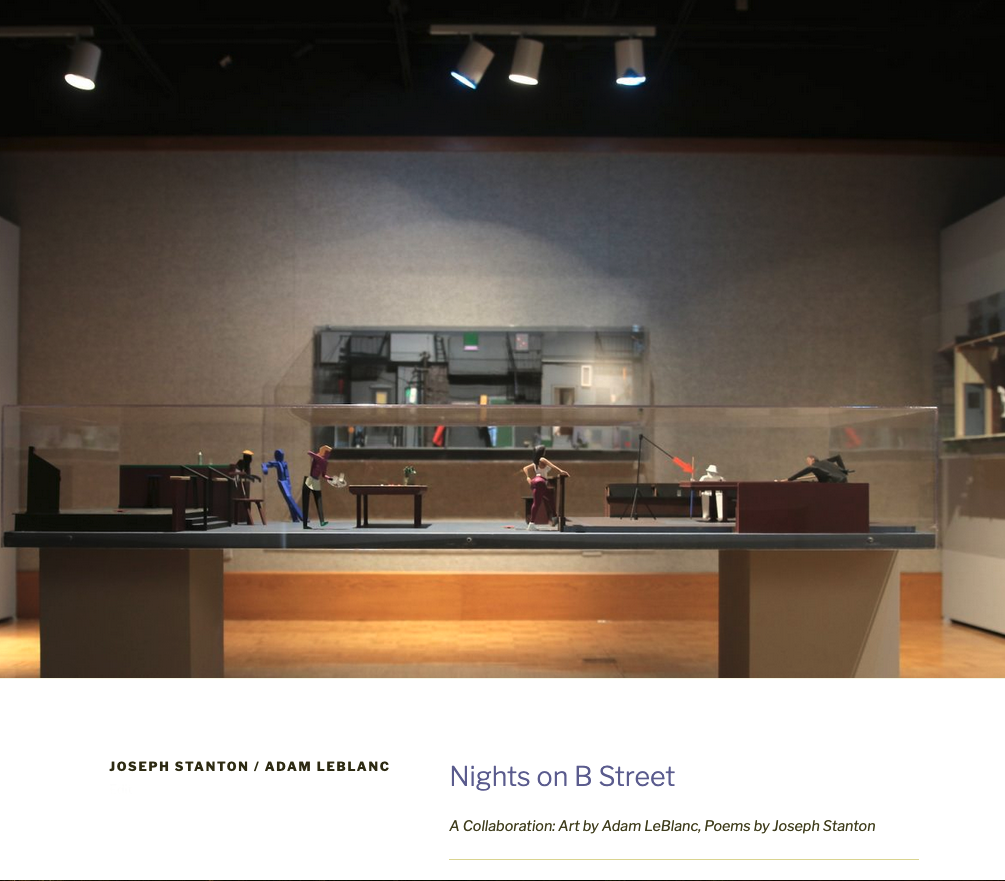
Fujioka: How did you and Adam LeBlanc develop your Nights on B Street collaboration?
Stanton: Nights on B Street is a work LeBlanc created—in its original, non-collaborative, version—in 1993. The seven detailed urban scenes were inspired by LeBlanc’s experiences and observations in various cities, but he had in mind primarily New York City and Boston, the Eastern cities where he had spent the most time. Nights on B Street was exhibited at the Linekona Gallery and was widely praised. I admired the show and often talked about it with Adam from time to time. When an opportunity arose for him to re-exhibit that show at Gallery Iolani at Windward Community College, Adam invited me to write poems that would parallel his pieces. Unfortunately, our Nights on B Street exhibition was installed in 2020 during the covid pandemic. We were not allowed to stage an opening for the exhibition, and only students and staff of Windward CC were allowed to see the show. Luckily, Gallery Iolani was able to make a video about that exhibition, which is still available online. Also, Pat Matsueda did a beautiful job of capturing details of that show in an article for the online journal Vice-Versa. It is good that our 2020 exhibition has been given an extended life in digital form. I am happy, too, that I was able to include my Nights on B Street sequence in Prevailing Winds. I was also able to include poems inspired by two of the paintings of Hawai‘i artist Kloe Kang in that book. Among other local artists, whose works inspired poems by me, are Ka-Ning Fong, Reuben Tam, Joseph Feher, Noreen Naughton, and Laura Ruby. My tenth book of poems, Stilled Lives, which is forthcoming in 2026, will contain more poems inspired by Hawai‘i artists.
Fujioka: Some of your nature poems in Prevailing Winds focus on extinct and endangered birds. What was the catalyst for those pieces?
Stanton: My poems on birds of that sort arose, in part, out of my efforts for the Aloha Ho‘omaluhia exhibitions. Many of the artists in that group are deeply committed to environmental causes. The influence of their interests inspired me to extensively research extinct and endangered Hawai‘i wildlife. Hawai‘i has a great many unique species. The onslaughts of development have impacted Hawai‘i so heavily that a large number of our unique species have gone extinct or are in danger of doing so. Over the years, I kept writing more and more poems about the difficult or impossible situations of Hawai‘i’s lost and at-risk birds. I include a number of those poems in Prevailing Winds. There is a sequence of poems on extinct and endangered Honeycreepers. A poem in that book that has gotten a particularly strong reaction at my poetry readings is “The Last Kauai ‘Ō‘ō,” which regards a particularly haunting extinction. There is, for me, an urgency about these poems. It has been suggested that Hawai‘i has experienced more extinctions of native species per square mile than any other place on earth.
Fujioka: What is your process when you are working on a nature poem?
Stanton: My process often involves a huge amount of research. Most of the research does not get used in the poem. The excess research I do for my poems inspired by artworks has always been useful to my day job as a teacher of art history. The research I do on the flora and fauna of Hawai‘i, however, is purely for the pleasure of trying to understand the world around me. I enjoy trying to be as knowledgeable about such things as I can. Once I have done whatever research I can manage to do, I move to the brainstorming stage. I play with ideas on paper or on my computer. Sometimes those brainstormings lead me to rough drafts for poems. From a rough draft, I move into the rewriting and revision stages. Sometimes I find my way towards a draft of a poem that might be viable; then it is just a matter of revision after revision.
Fujioka: What is going on with your recent books and works in progress?
Stanton: I have been very fortunate in recent years. Several books of my art-inspired poetry have found their way to publication. Things Seen was brought out by Brick Road Poetry Press in 2016; then my next four books were published by Shanti Arts—Moving Pictures (2019), Prevailing Winds (2022), Lifelines: Poems for Winslow Homer and Edward Hopper (2023), and Kaaterskill Clove (2025). Shanti Arts is an independent publisher of fine books located in Maine. Shanti Arts beautifully designs each book and includes full-color reproductions of many of the artworks on pages facing the poems. My tenth book of poems, Stilled Lives, will also be published by Shanti Arts in 2026. As mentioned previously, Prevailing Winds contains many Hawai‘i nature poems as well as an array of art-inspired pieces. Although poems about paintings dominate many of my “ekphrastic” books, there are also, in those books, poems that respond to Noh plays, fairy tales, sculptures, poems, and movies.
Fujioka: Joseph, what a pleasure and a privilege to conduct this interview. Thank you so much again for joining us to celebrate national poetry month. I appreciate your taking time from your busy schedule to meet with me. I look forward to reading your new collection.
Links:
Seven Poems in Vice-Versa
https://www.hawaii.edu/vice-versa/joseph-stanton-2024/
Video of Nights on B Street
https://www.youtube.com/watch?v=cWwni__EwS8