
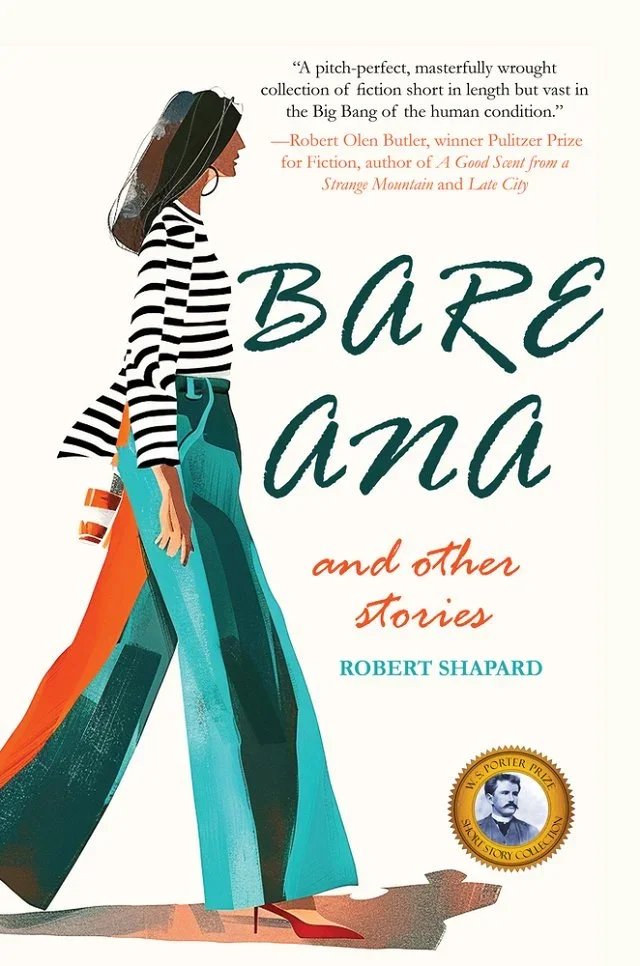
This interview with Robert Shapard was conducted after the publication of his volume Bare Ana and Other Stories, described by novelist Steve Heller as “finely crafted stories [in which] Shapard’s clear and insightful vision of humanity shines through.” Shapard “proves himself to be not only an accomplished editor but a master practitioner of the shortest prose forms. Most of these narratives end with a subtle manipulation of point of view that turns the reader’s perspective to a different angle.”
Do you try to keep friends, family, and acquaintances from appearing in your work? Why or why not?
I don't keep friends, family, and acquaintances out of my stories. They're everywhere, I just don't give them their "real life" names. Isn't that a rule of fiction? Maybe not as much as it used to be.
But I mess with real-life people, use parts of them, mix them up. In the story "At the Back Door," the real friend I modeled the protagonist on never repossessed a car. He and the story-him were indeed champion swimmers and had a hundred jobs selling everything from real estate to BBQ sauce, as in the story. The real-life him went to my high school, and we were in Marine Corps boot camp together. A different real-life person did the death-defying back dive off a highway bridge.
The opening story of Bare Ana, "Thomas and Charlie," is almost exactly a real-life event. That's me in the back seat of the car, observing a wreck happening ahead. (My brother was there, too, but I got rid of him.) The driver of my car is less my father than my uncles; that's not exactly my mother either, though she did keep the water jug.
About the story "Turtle Creek," everyone I've told the story to has looked startled and said, "That was my high school class." There is one non-fictional character in the collection, in the story "Best Boy"—it's Boris Karloff, the original Frankenstein's monster. Though of course the scene is all fictional.
Now that I think of it, most of my stories have no friends or family in them and are totally made up. Yet I feel that everyone I've ever known is in all the stories.
I have gotten old enough to be the person I longed to be when I was young. How do you feel about getting older?
I think I've gotten to be the person I didn't know I wanted to be when I was young. As a youth I wanted to box in the Golden Gloves. I wasn't afraid to get hit. Indeed I got knocked out on my feet, once, in a backyard fight. The world was black for several long seconds as a stood there. When my vision came back, my opponent was standing there and I went at him in a fury until he cried quits.
But when I actually went to a Golden Gloves tournament (not as a contestant) for the first time, just the idea of being surrounded by a crowd in the super bright lights of the ring gave me a terrible stage fright, and I gave up my boxing ambitions.
Now I no longer get furious or shy, though I’m still full of contradictions. Aren't many of us? To answer your question (at last), I've wondered who I might be if I were one character in the collection. My guess would be the young husband in the title story, "Bare Ana." He's clueless about some things while discovering dragons in the sunset.
There are tinctures of irony and bitterness in your stories. Can you say what personal or professional experiences these represent? Or are they wholly invented?
I think irony was a family trait. Each of us, my brother, cousins, parents, grandparents, all living in the same house, had our own brand. My engineer grandfather was the boss, a skeptic who delivered ironies in one liners, with a laugh like a punch. My grandmother led the march for women's right to vote in our town, bet on horses (the bookie came to the door at dinner), and spoke her ironies in proverbs, like "Birds of a feather flock together." Birds could include any group such as idiots. But she was forgiving of human frailty and was by nature wise, kind, and generous, and everyone loved her.
My ironies were weird. I liked to draw cartoons. One was a huge fat mobster man in an overcoat wearing a homburg carrying a whip. He stood on a flat, wheeled cart apparently pulled by a dog. But the dog wasn't pulling. She was in a harness but lying on her side, suckling her newborn puppies, giving the fat man a pleading look. A dialogue bubble for the fat man said, "Damn dog." I have no idea what it meant. I just thought it was hilarious. I showed the cartoon to my mother, who gave me an uneasy glance, like My child is disturbed. But, always encouraging, her words were something like "My, how interesting."
None of us was bitter about anything, except my father, late in life. He was a great guy, but had become an alcoholic, precipitated by medical problems. He tried to commit suicide several times and finally succeeded. This is the story "Dummy," which is my oldest story in Bare Ana. The event depicted in the story happened just a year before I became a student in a writing program. I'd come late to fiction and was still trying to figure basics out. I remember reading Donald Barthelme's The Dead Father, which was recent, though now called a classic of postmodernism. I couldn't figure it out. But it may have prompted me to write about my father's suicide. What I really wanted to know was how you translate real life to fiction. I applied fiction techniques, such as images and dialogue, to memory, trying to capture a true event of an afternoon.
But a strange thing happened. The story took over. It demanded (that is, ideas kept insisting) that my father die at the end. In truth it was just one of my father's suicide attempts. (In real life he was up and walking around the next day, arm bandaged, having a drink.) Yet rereading, now, I see everything in the story led to his death. And the story, to be honest, convincing, and true to itself, wanted to deliver. So I wrote an additional truth, for my narrator. He didn't want his father to be dead, so his mind created an additional reality. And the story couldn't argue, because after all this reality could be true as well. So the father was dead and not.
Later I sent the story to a magazine, Fiction International, where, they told me, it created an argument among the editors about what fiction should be. Anyway they published it. In real life, I did finally discover my father's dead body, in a car in a sealed, smoky garage. It was carbon monoxide that got him. The car was still running. A slightly different set of police from the ones in the story came.
Does aging affect what you write or how you write?
William Butler Yeats said, "An aged man is but a paltry thing, a tattered coat upon a stick." I see a lot of them in the café of our Whole Foods grocery afternoons as I take my place among them. Often they're wearing REI hiking gear and Kizik step-in shoes. As I unfold my laptop, I don't feel old, not any older than the Internet. It's true the other day I got irritated at forgetting my great aunt Lowe's husband's name. But in a minute I remembered Uncle Arthur! With his vicious chihuahua, Pepe. God bless them, they haven't changed in sixty years.
But my writing has changed. I grew up with no sisters and barely knew any girls. All the pets were male! So when I started writing stories, they were all from a male point of view. If I tried to add a female point of view, female readers would give me a look and say, "Weird." But I kept trying. I liked discovering things from the women's side. Eventually I realized the woman and the girls had always known everything. Now, in my second childhood, I'm writing a novel about a twenty-year-old boy, or man. Maybe male readers will say "weird." Were I W.B. Yeats, I might reply, "Soul clap its hands and sing, and louder sing / For every tatter in its mortal dress."